PROJECT 04 / March 2026
Exhaust bracket design and FEA
Material selection and a cast iron geometry redesign
Michigan State University
How do material and geometry choices balance stiffness, strength, and cost?
My contribution
I modeled an L shaped exhaust hanger bracket under a 311 N static load. I compared seven candidate materials using beam calculations, static finite element analysis, nominal strength, stiffness, and raw material cost. The initial screening favored AISI 1018 quenched and tempered steel.
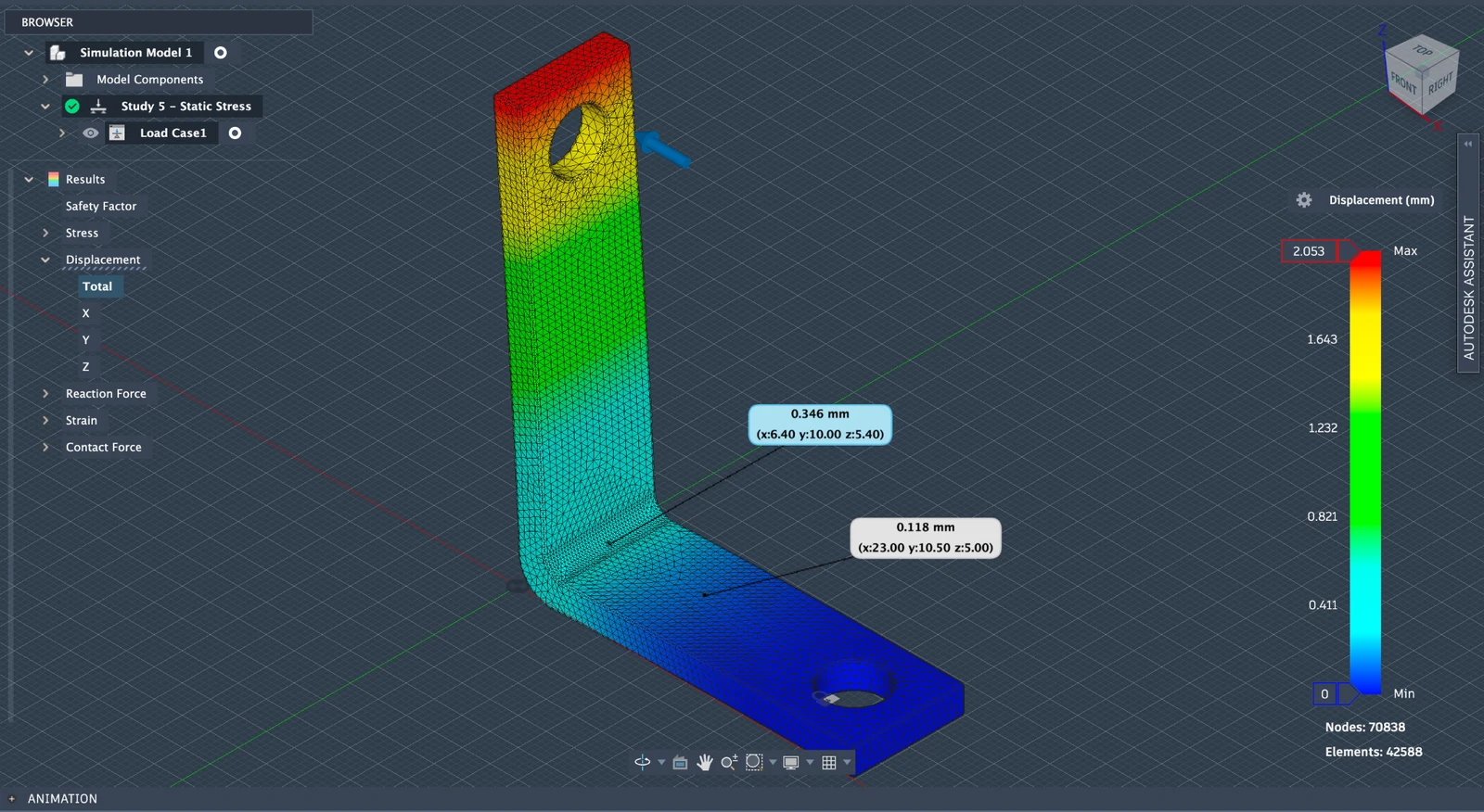
For the steel model, Fusion 360 predicted 2.053 mm of maximum displacement, compared with 2.184 mm from the beam calculation. I reviewed stress concentrations near the inner fillet and the fixed mounting region rather than treating a single solver value as the full design assessment.
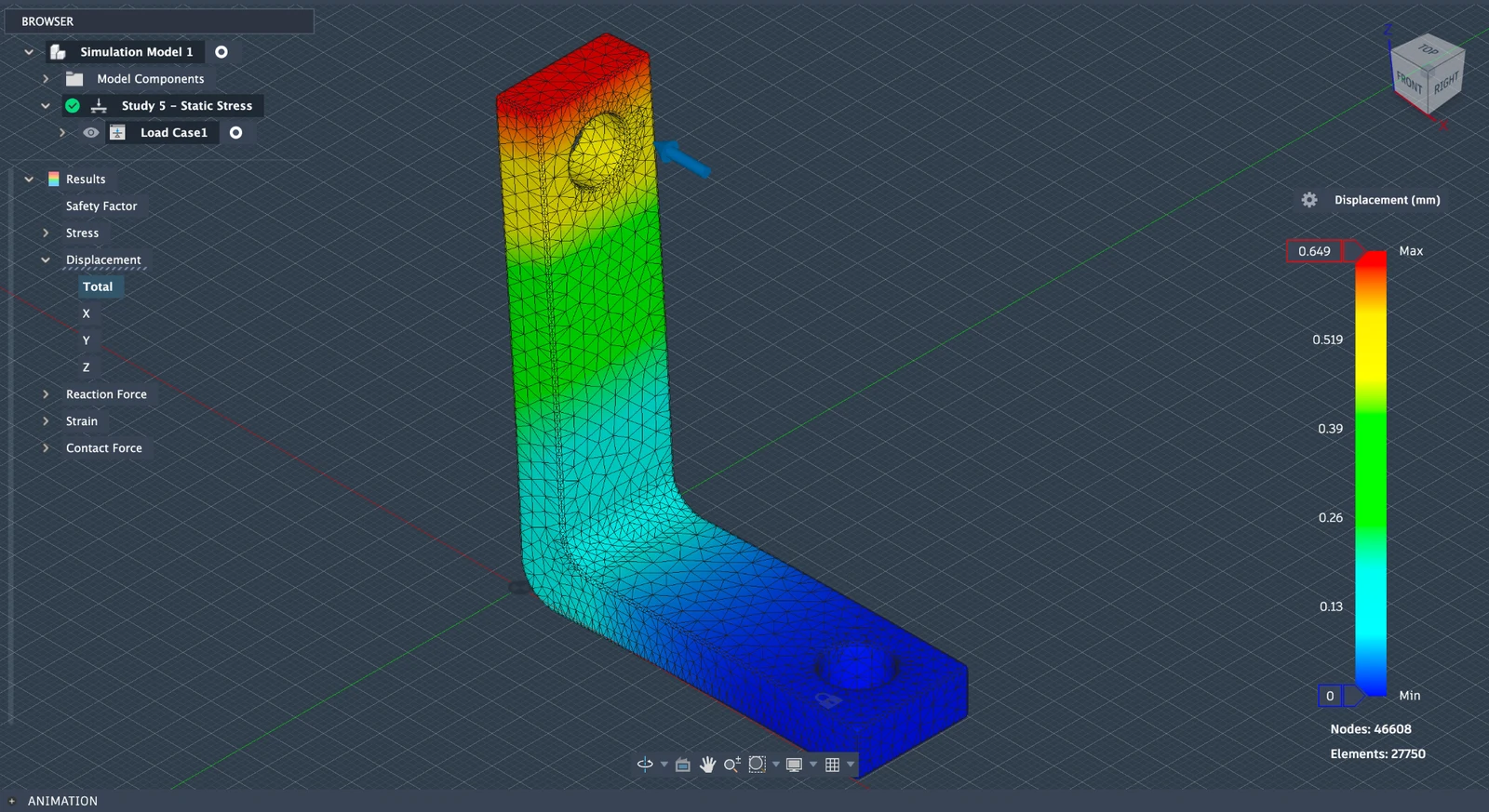
I then explored a cast iron version. I increased the bracket thickness from 5 to 8 mm and the inner fillet radius from 3 to 5 mm while retaining the mounting holes. The revised model predicted 0.649 mm of maximum displacement. I compared three meshes and examined the local principal stress near the fillet to assess how the result changed with refinement.
The two models use different materials and geometries. Their results describe the modeled static load and idealized mounting constraints. Physical testing, fatigue analysis, and a more detailed model of the bolted connections would be needed to assess the bracket for service. I also considered casting, machining, and the limits of using raw material cost alone to compare manufacturing options.
Screened seven materials and developed a cast iron redesign with 0.649 mm modeled displacement.
The process
- 01
Define the load and screen candidate materials
- 02
Compare beam calculations with static FEA
- 03
Revise the geometry and examine mesh sensitivity
Source: Material selection, geometry redesign, and FEA reports supplied by Daniela Ojeda.