PROJECT 07 / April 2026
Rotating shaft redesign
Combined loading, fatigue, and material selection
Michigan State University
Can a geometry change address shaft failure while retaining an economical material?
My contribution
I helped lead the team and contributed across the design, analysis, and reporting work.
Our team evaluated a stepped, keyed shaft for a rock crushing application under a 109 lbf bearing load and a peak torque of 2,650 lbf inches. We compared four candidate steels using static strength, fatigue, keyway stresses, deflection, and estimated material cost.
The original geometry failed at least one screening criterion for every candidate material. The small output diameter and shoulder stress concentration drove the redesign. We explored changes to length and fillet radius before increasing the output section diameter from 0.748 to 1.181 inches, removing the original shoulder transition. That change also meant the mating component would need to be revised.
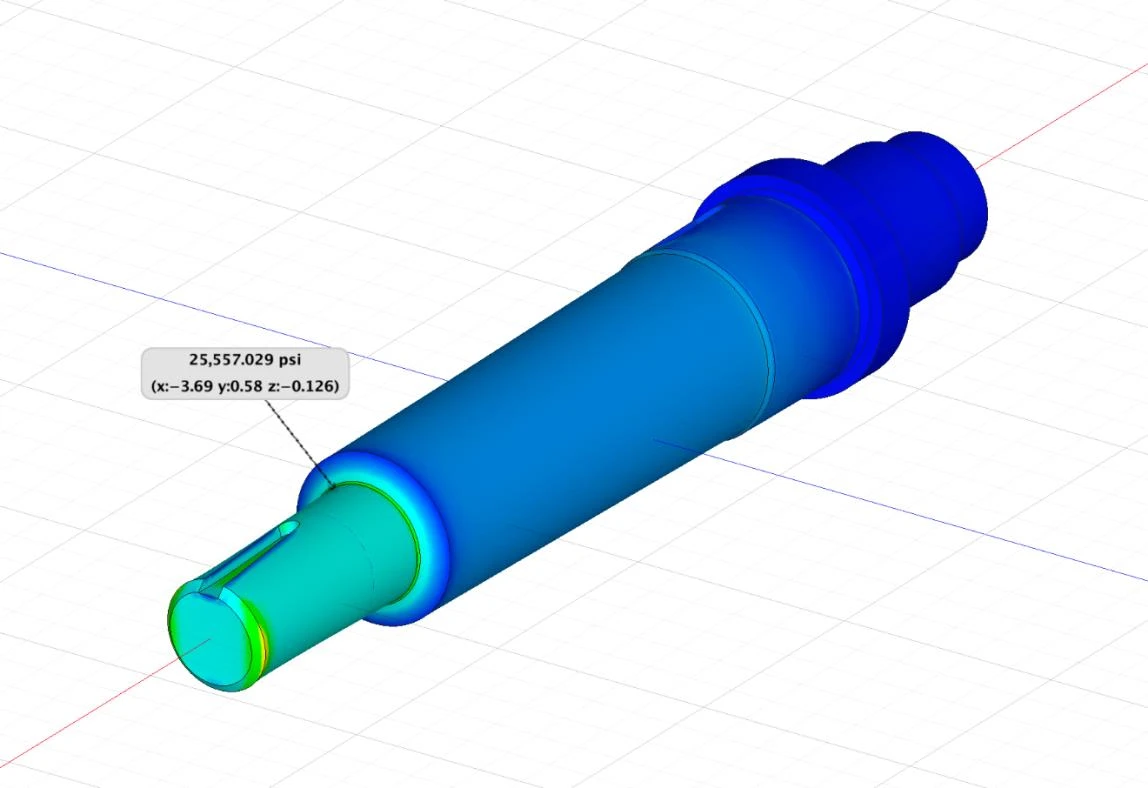
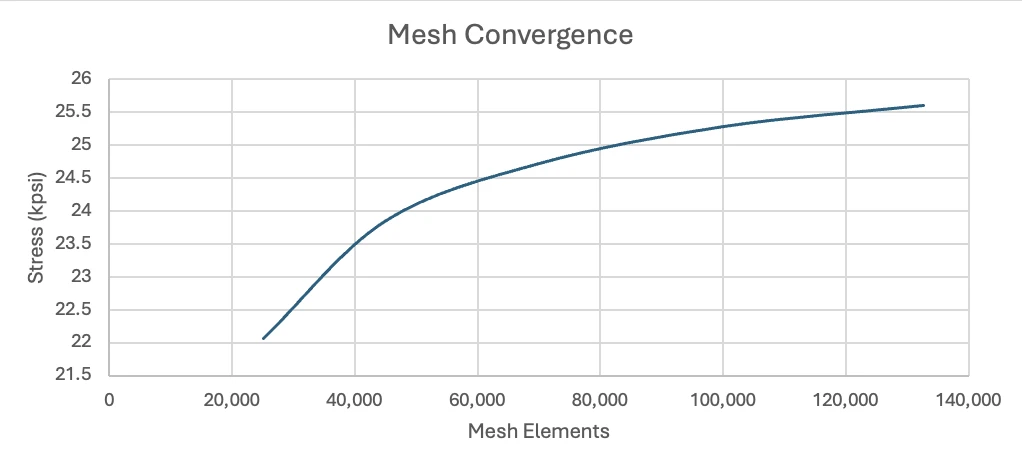
The team used hand calculations and an Excel spreadsheet to compare diameters, then evaluated the revised geometry in Autodesk Fusion 360. Local mesh refinement at fillets, chamfers, and keyways produced a reported stress near 25.6 kpsi at the critical chamfer. The final refinement changed that reported value by 0.86 percent.
The report recommended hot rolled AISI 1045 based on the revised calculations and material cost comparison. It reported a static factor of safety of 2.23 from hand calculations and 1.85 from FEA, with a modeled displacement of 0.006 inches. Those differences, together with the localized stress at an end constraint, need further review before accepting the design for service. This project is a design study rather than a physically validated shaft.
Compared four steels and revised the governing shaft section using calculations and static FEA.
The process
- 01
Screen static, fatigue, keyway, and deflection criteria
- 02
Iterate the output diameter and compare material options
- 03
Compare hand calculations with refined FEA results
Source: Team rotating shaft design report supplied by Daniela Ojeda.